Getting Meta Made Me Better
Episode 7: Beginning our Adventure into Motivation, Balance and Values

My wonderful, patient girlfriend Alice is sick to death of hearing about this from me. Don’t read any further my dear. You would have heard endless droning monologues from me on this topic - nothing is new from here on.
For the rest of you, sit down and listen up. When this was just a collection of documents with little form or direction - I had written a page or two on the mental approach to running. It’s an important element of training and management, but I’m a physiotherapist, not a psychologist. I need to stay within my scope.
For the majority of my time spent as a runner, my mental approach has been so poor and required so much work. It feels fraudulent that I hand out running advice much less life advice.
So, I’ve decided to not give out any advice. If you see any in this post it’s a typo, and should be instantly disregarded. All I’m doing is recounting some thought processes and experiences that I have developed and with help from more experienced people. Take the following with a grain of salt. Some of this will stick with you, some will not - take on board the elements you’d like to apply to your own training, and leave the bits that don’t. Unsubscribe angrily if you’re most annoyed at this sort of content.
I don’t have it all figured out. This isn’t advice.
“Don’t be afraid of high expectations but equally realise you won’t always meet them. This can be stressful but valuable learning.” - My mum (1969-2015)
Finding My Why
Sometimes I play with my thoughts like I would stretch and flip a rubber band between my fingers. It sounds like a load of semi-intellectual poetic wankery, but it's the best way I can describe it. I’m sure we all do it in one form or another. We might simply take a thought and view it through a range of lenses and perspectives, mindlessly playing with it for no other reason than for the fact it’s there. Often I do this just to fill my time, before it is placed to one side and forgotten once I’m done with it, just as I would with a rubber band. Sometimes the thought snaps unexpectedly, and it snaps back on me causing me to flinch. “Ooh. That’s enough playing with that thought.”
One of the methods I frequent involves using the typical conversation tactic of a four year old, and keep asking myself, “why?” It does lend itself to being a touch existential, but on the whole it’s a gentle way to observe my decision making and ponder what matters to me.
If you’re willing, follow along with one of the avenues this took me on the other day:
“When I wake up in the morning, why do I get out of bed?”
Well, Isaac, I need to get to work on time.
“Why do you go to work?”
One reason is I need to make money. And, on the whole I enjoy my time there too.
“Why do you need to make money?”
Well, I need to make enough to cover the basics and survive, but I guess I also have running trips coming up that I’ll need to book flights and accommodation for. It’s also Alice’s birthday coming up and I want to get her something good.
With a few short questions, the things that are important to me rise to the surface. We can stretch the rubber band a bit further.
“Why are you going away for running?”
I want to be in a fast race with good competition so I can run a quick time for the half marathon.
“Why do you want to do that?”
Hmm. I don’t actually know. Why do I want to run a fast time?
So I think about that for a bit. The cursor on my document blinks at me while I try to come up with a justification for the passion I direct most of my time and energy into. Do I want other people’s praise and validation? Maybe, but not really. Besides, there’s easier ways to get that. Is it so I look good and stay healthy? Not at all, I’d hit the gym if I wanted to do that. Is it just because I’m good at it? Sort of. I’m good at other things too though, so why pick running?
Why do we do anything?
After some pondering, my answer is something like this.
I want to excel at something and do it incredibly well, so that people stop telling me how hard I’ve had it. What I choose to do can be anything, it doesn’t have to be running. But I want to prove a point that I can overcome the challenges in my way. Running a fast time is an outcome that objectively shows I am achieving the goals that I set for myself, and that I can overcome challenges. That’s why.
Ooft.
More often than not, the thought experiment doesn’t go that deep. And I didn’t happen upon that answer in fifteen seconds. It’s taken the best part of ten years to arrive at that conclusion.
But on the days when it’s raining and I’d rather not go for my run, it gets me out the door. When I’m blowing up in the Zatopek:10 and want to step off the track, it keeps me ticking off the laps even as everyone else flies past. Late in a race when I need to go to another gear, my why helps me find it.
I like knowing why I do things. You might not and that’s ok. I’m not here to give advice. Just explain why I run.
My why helps me find motivation. This sometimes tips into obsession.
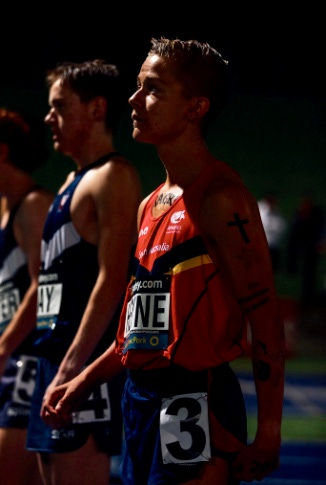
There is no doubt having a reason bigger than myself helped me win this race in 2019. I was coming off injury, and had only been able to train properly for 6 weeks. Raising money for the Cancer Council, I covered myself in temporary tattoos designed by donors for this race. Hampered by my lack of fitness, I had use everything I had in a sprint finish to the line. I wouldn’t be able to do this if I was only running for myself.
Motivation, or Obsession?
When the going gets tough, the tough get going.
Who’s going to carry the boats? Stay hard!
Just do it.
Many people and corporations have established memorable quotations and catch phrases that inspire the average punter to chase after legendary status. It’s a good way to make money. In a world where commitment is fleeting and distractions are rife, sticking to your running plan 100% perfectly might be considered a win. Don’t stop, no matter what! Hell yeah I’m hot shit, I’m more committed than the common punter.
But buyer beware! Doing too much, not listening to your body, pushing through no matter what - these are things that can lead to burn out and injury. But giving up and stopping at the first sign of discomfort or hardship? That doesn’t lead anywhere good either. This delicate balance is one of the keys to playing this running game. The artistry, the magic and the sheer beauty of this passion lies on the knife's edge that separates “too much” and “not enough.”
How do we know which side we fall on? How do we know if we’ve got it right? Even those at the top of the game struggle with this, often overdoing it. How one person responds to a particular situation will differ to how another would. This is true in all things life.
One question I pose to myself is what sort of person I usually am in the environment I’m in. This could relate to work, family, running, cleaning the house, writing an angry comment online: anything. Am I more Type-A or Type B?
It's important to remember that we fall across both categories. No one fits neatly into one box. Most of us exhibit a mix of personality traits; for example I can be very planned, workaholic-esque and competitive when it comes to my running, but relaxed, laissez faire and somewhat disorganised when it comes to organising date nights with my girlfriend (she loves it).
Like I said - I’m no psychologist, I’m not here to psychoanalyse you - but knowing my default response mode helps me guide my decision making when it comes to adjusting running plans. If I’ve got some soreness, and I have a long run coming up, I know I’m more Type A - so I try backing off more than I feel comfortable. It doesn’t always work but it’s one strategy.
Even as a physiotherapist, I like to ask people how they’ve responded to previous injuries to get an idea on what their default response is. I don’t classify or categorise them, but knowing their decision making process can help me decide whether they have some capacity to push harder, or if they tend to overdo it.
This process only works if I’m honest with myself. Sometimes I lie to myself and pretend I’m more relaxed than I actually am. Or I fake being uber-motivated when I’m not. It doesn’t get me very far. At my best, I’m honest, and I sit with the discomfort of knowing who I am. I make a good decision based on that.
The physical discomfort of running is only one part of it. We face mental discomfort and emotionally challenging situations, and we have to overcome them. That’s why we love it.
A Bit More on Balance
Funnily enough, balance isn’t a fixed place with a permanent address. It’s dynamic and fluid, the balance one day calls for will be different to the balance required for another.
Steve Magness, quite the Twitter guru on running, has a great tweet saying:
“Balance in life is BS.
To achieve almost anything, there are periods where you have to go all-in and singularly focus on one thing. That's fine.
The key is being able to step back when YOU choose to.”
With a race or a deadline coming up, you will be required to turn down social events to train, sleep and recover. That’s ok. But there are also weeks and months where missing a run for a social event might be more enjoyable, or even necessary. That’s ok too. I don’t have the answers on how to navigate life and determine how much balance is required day-to-day. My life is messy.
With that in mind, take or leave the following. I suspect that deep down we require some level of instability. Not so that we’re out of control, but enough to keep things interesting. Why else do we tackle challenges head on and commit ourselves to trials that we might fail at? The art of problem solving and balancing in itself requires problems and instability. Children love the playground equipment that’s the most dizzying and exciting. We applaud gymnasts as they tumble through chaos before landing on their feet. We take on a running challenge that push us to our limits. The best and most beautiful things in life are in the struggle of balancing out unbalance.
Values
I don’t have the knowledge, qualifications or lived experience to speak on balance. Jonah Oliver does though, and he talks about it on a Dyl and Friends podcast episode in 2022. He highlights the importance of having personal, intrinsic values to provide a roadmap for life’s decision making. Knowing what is important to you and what you stand for can help to answer the questions posed to you by life, other people and yourself.
Motivated and inspired, I have attempted to articulate and define my own values. These haven’t rashly scribbled out, but developed, evolved and tested over the course of a few years. They still aren’t perfect, but so far I’ve come up with:
Courage
Justice
Building Others Up
Whilst pretty vague and seemingly simple, I know what these words mean to me. Some of my proudest moments have been when I’ve actively lived these values out, and the moments that keep me up at night are when I’ve chosen not to. These help keep me on the path I know I’d like to follow, and help me determine when to charge on and chase my goals, but also when to chill out and take a moment to relax. I don’t follow these perfectly, but when I do I find my point of balance.
I love being courageous and taking it on in a race. The “ballzy” persona is something I try and live out in running and in life, but sometimes it doesn’t pay off. I’ve had many races where I ran poorly, but I need to get around my teammates who have run amazingly well. They deserve the praise, it’s the just and right thing to do. Building others up when I am down doesn’t come naturally to me, but the rare times I’ve done it well give me a sense of satisfaction even the best race couldn’t provide.
When faced with hardship, discomfort or simply a fork in the road, my values help guide me to make the right decision that sits comfortably with me. They let me know when to push, and when to step back. These motivate me to the point of obsession, but stop obsessions from being all-consuming. In times where life and running are seemingly unbalanced, my values help right the ship and stay the course. Is it a perfect system? No. But so far, so good. I’ll reassess them when they fail me.
I don’t know what your values are. You’ll be able to figure it out if you spend the time on it. One method I used was reflecting on moments I was proud of - and analysing what theme they all had in common. And conversely, for moments that sat uncomfortably - what were the common themes that were absent?
Running isn’t that deep, but also it is. You’re actively choosing to put yourself through an uncomfortable situation, and regularly. For what? Why are you doing this? I don’t have the answers for you, but they’re out there somewhere. Seek, and you shall find.
Knowing why you do something and understanding what’s important to you can help can help you make better decisions. It can keep you motivated, but stop you going too far.
We’ll leave it at that today.