Rest and Ratios
Episode 15: You Can Like and Subscribe - Or You Could Implement This In Your Training

Enough of the palaver - let’s get straight into it.
Rest
Rest days are crucial for injury prevention and performance enhancement. Something I can’t stress enough - your body doesn’t get fitter and stronger from the running itself, it gets fitter from the adaptations that our body undertakes to maintain homeostasis and build fatigue resistance. These adaptations take time, and require time off running to occur properly.
How often should you be resting? As you start your running journey, you’ll need at least a day or two between runs to allow your body to recover from the consensual torture you put yourself through. Maybe even more, it depends on how hard running is (if you find running is so hard it takes four or five days to feel normal again, go slower. If you can’t go slower, add some walk breaks).
Our bodily tissues recover and heal from damage, strain and stress following a timeline that looks something like this:
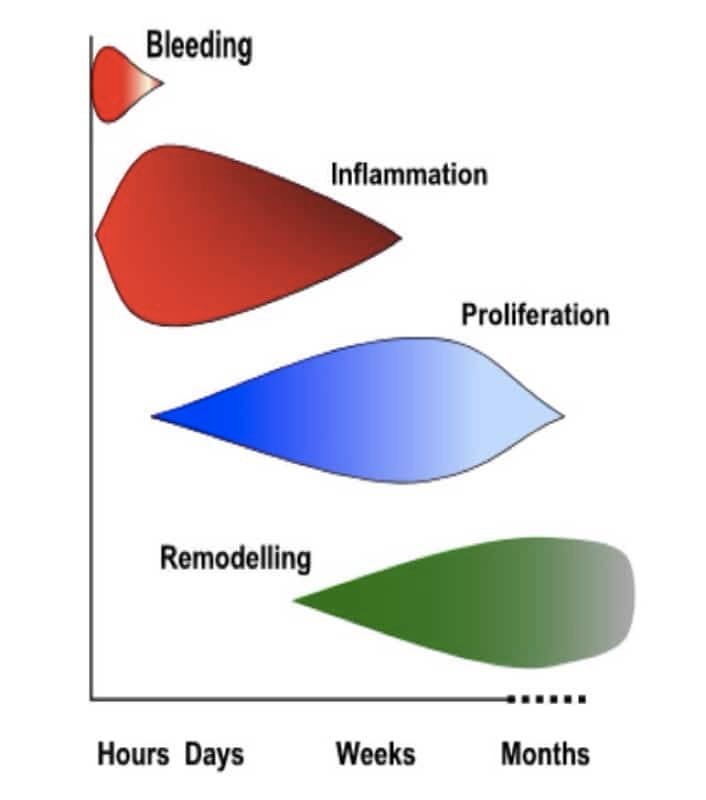
Early stage healing requires a period of inflammation - which peaks around 1-3 days. The more experienced a runner is, the more efficient and strong this system is at absorbing and healing running related tissue damage. It’s shown that experienced runners have a higher number of anti-inflammatory cytokines (IL-10 if you’re interested), resulting in a relatively smaller inflammatory response compared to their lesser-trained counterparts. Novice runners with less efficient and robust systems have a larger acute inflammation period, which means more time is required for it to calm down. So rather than continually stirring up inflammation and tissue damage and running day after day, newer runners need to allow it to run its course before going for their next run. Do experienced runners still get inflammation? Of course. But if we consider the impact that a 5km jog might have on a ultra-marathoner compared to someone going for their first run in 10 years, we can understand the practical implications of a relative inflammatory responses.
So when do you begin adding in extra runs and resting less? If you refer back to the diagram, tissue generation (proliferation) and remodelling takes a period of weeks to months (and actually continues on for years!). This is why we gradually increase training loads using tools like the Acute:Chronic Workload Ratio (more below); subtle changes over weeks and months allow for training improvements while patiently waiting for tissue remodelling to occur. While I could suggest a definite time frame, it would be inaccurate for everyone in a variety of constraints. Paying attention to your body’s feedback signals and following a safe running program will hold you in better stead.
There’s no hard and fast rule on resting. One crazy example: Devout Mormons Connor Mantz and Clayton Young came 8th and 9th in the 2024 Paris Olympic Marathon, with training consisting of 190 km weeks, and a day off on Sunday. Some runners at this level might take one day off a fortnight, and some even don’t take a rest day.
The first few months returning from bone stress injuries I took 2 days completely off each week to allow my bones a chance to proliferate and remodel properly. Nowadays I take one a week. It’s individual, and will be different for you now, previously and later on.
Another important aspect to resting is having longer periods of down time, or periodised rest. Even with a rest day, week after week of training takes its toll physically and mentally. Running performance, just like life, has its ups and downs - and you can’t be up all the time. Scheduling in down time means that downs (injury, sickness, excessive fatigue) aren’t forced upon you at inopportune times. This doesn’t have to be complete rest (although often is), but can also just be a period of time with less volume and intensity. Again, there’s no hard and fast rules to this. You should be looking at having some down time after big races where you’ve pushed the RPE up to 10 - but for how long is largely individual. My first running coach had a rule of thumb where his athletes would have a number of complete days off that matched the amount of miles they raced. That meant three days off after a 5km, and 26 days off after a marathon. With better footwear, a lot of people are back training much earlier than this - but it’s not bad advice if running isn’t your job where you’re required to run races for your income. That said, David Rudisha, the smoothest and most fantastic 800m runner of all time, took 3 months off after his world record breaking Olympic performance in 2012. While 800m running is not quite distance running - his attitude reinforces “less is more.”
We’ve touched on Periodised Training in a previous post, for more specifics and physiology, give it a read.
If you aren’t a runner who’s looking to target a race, time off might come when work or social demands are higher. Running on holiday is difficult, and maintaining normal running volume when you’re slogging out extra overtime each night isn’t sustainable. If you’re a planner, looking forward to busy or fun times of the year can determine when you might schedule some time away from running.
You can rest, and should rest. The swamp says that you should push and push and push, and when you break you should push more. This isn’t sustainable - for you or your private health fund. There is nothing “high-level performance” about that approach. Regular breaks, and periodised long ones, mean you can push just at the right times, and just the right amount.
Acute:Chronic Workload Ratio
I can’t remember if I’ve written on the Acute:Chronic Workload ratio already, but it won’t hurt to go over it again just in case. We can call it the ACWR for short. It’s a great tool to use to review your training, or plan training going forward. The ACWR should help you answer the questions, “Am I running enough this week?” and vice-versa, “Am I running too much this week?” I must stress, it simply provides a guide, and gives no guarantees on injury prevention, but it is worth using as it has been developed through large sample sizes with a certain level of applicability to runners. Now bear with me, it gets a bit mathy - but it’s pretty simple. You can use chatGPT to help if you need.
A Basic Calculation
First, we need your acute workload. You can make this as complex as you need to, but to start we’ll keep it simple. For a distance runner, acute workload looks at the amount of running you’ve done in one week. Most people measure this in kilometres or minutes (unless you’re American and measure it in bald eagles). For those beginning running, I use minutes. Once the weekly running gets bigger, kilometres are easier to use.
Your acute workload (one week’s training) is then compared to your chronic workload, which is the average weekly running for the last 4-8 weeks of training you’ve done. I tend to use six weeks for those I see in clinic, but will go up to 8 or 12 if there has been a series of events causing some inconsistency and variation from the norms of training.
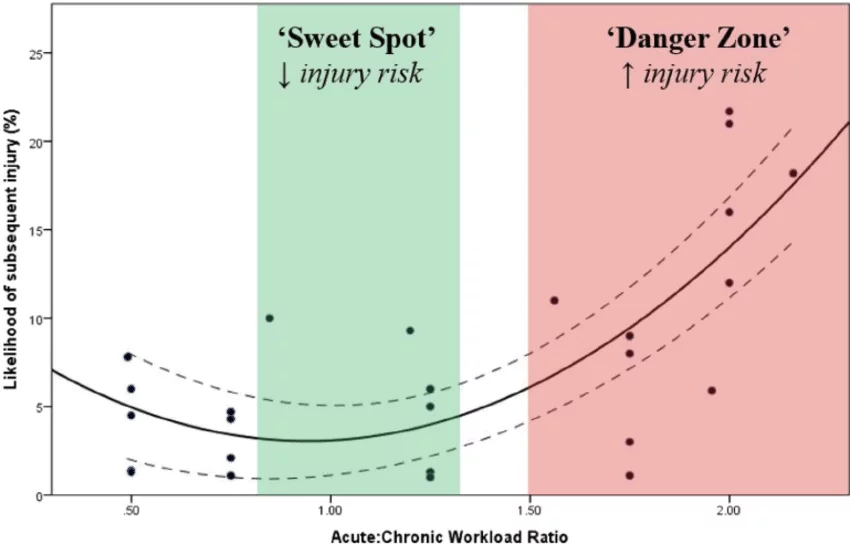
You then divide your acute workload by your chronic workload, and it should pump out a number *hopefully* in the range of 0.8-1.3. That’s your ACWR. You don’t have to be Walter White to work that one out.
Research into running training suggests that a safe and effective ACWR should be between 0.8 and 1.3. Below 0.8, and you’re probably not running enough for it to help you improve. Above 1.3 and your risk of injury increases rapidly. Now this isn’t a perfect tool, but it's a quick and easy way to plan future training, and reflect on training errors if you end up injured.
If you aren’t a Walter White and more of a Jesse Pinkman, I’ll give you an example. Alice had finished her first four weeks of training after an ankle injury and wants to plan her fifth.
Week 1: 9 minutes of running
Week 2: 25.5 minutes
Week 3: 36.75 minutes
Week 4: 34 minutes
Weekly average: 26.3 minutes (this is our chronic load)
For her training to be effective, her weekly training needs to be above 0.8 of 26.3 (21 minutes). For her risk of injury to be lower (not zero), her weekly training needs to be below 1.3 of 26.3 (34 minutes).
As you can see, it’s a slow progression! Running is a patience game. Of course there are outliers, some people who will be able to progress really quickly, and those who will progress really slowly. The ACWR is a good guide for the general population to minimize risk (but not completely remove it). If you’re anything like Alice, the maths to figure out your training load can be tiring and cumbersome. It takes the joy out of running; this is why coaches have a job. However, if you can wrap your head around this, it means you can look at what your coach/online program/boyfriend has prescribed you and see if it is safe and effective.
Incorporating Effort to the ACWR
Now, for the more experienced runners who are varying the intensity of their running. High intensity sessions should be accounted for differently in your workload than your easy runs. 30 minutes of intervals takes more of a toll on the body than 30 minutes of jogging. How do we calculate this?
There’s no perfect way to do it - but we could consider monitoring our training in arbitrary units called “Workload Units.” These are calculated by multiplying our RPE (effort levels out of 10) by the minutes spent at that RPE.
Alice wrote out the next week of her training, where she planned to do a 30 minute easy run, and a ParkRun (aiming for 30 mins). I suggested it might be a bit of a big jump. We can calculate her Workload Units as follows:
Easy Run Workload: 30 minutes x effort level of 3 = 90 Workload Units
ParkRun Workload: 30 minutes x effort level of 9 = 270 Workload Units.
As you can see, this format weights harder runs as a higher workload. It’s not perfect, but it’s a decent format that gets used regularly.
So as your training becomes varied in intensity, rather than using distance or time, your weekly training load can be calculated by adding up all your runs in these new Workload Units. From here you can calculate your new ACWR by comparing one week's Workload against the previous six weeks average.
Maths lesson done.
At this level of running, it might feel like a bit much keeping track of each week's training load while also trying to increase your running and manage the rest of life as well. Alternatively, you might become a bit too obsessive and intense about tracking your training load. That’s a reason you have a coach - they should be looking at this for you and planning accordingly. But if you feel like you aren’t coping with the amount of running you’re doing, or not responding to the training you’re completing, it’s worth knowing these tools so you can look back on what you’ve been doing and get an idea for yourself.

Here I am taking a short break after a Cross Country race. Thanks to a lack of rest days, and an ACWR well above 1.3, I was unable to stand on my left leg thanks for a femoral stress fracture.
Thank you for reading, and an even bigger thank you if you are enjoying.
I've just started watching Clayton Young's YT playlist on his 16 week Marathon build going into Paris Olympics. Great quality video's.
Great article Isaac, how does the ACWR apply to runners coming back from injury? Should they aim to stay within the limits of the ACWR or are they less at risk when increasing volume since they have done that level of training before?